This post was published on Oct 30, 2026 | Updated on Oct 30, 2026
Your car is booked in for repairs. Your first meeting is across town, the school lift still needs doing, and the alternative transport costs are building up by the hour. What would it take to keep your day running?
This Transport Month, consider how much of your routine depends on your vehicle, and what arrangements you would make without it. We spoke to iWYZE Head of Operations, Weliswa Radebe, about the practical and financial questions worth asking before your car is off the road.
For Weliswa, the reality is obvious: for many South Africans, a car is no longer just a luxury. It has become an essential part of daily life.

How South Africans get to work
"For me, the role of a vehicle hasn’t necessarily changed, but it has expanded," Weliswa notes. "As more people have access to employment and economic opportunities, more people are able to own their own vehicles. A vehicle is more than a mode of transport. It's what keeps you connected to the people and places that matter, while offering convenience and confidence wherever the road takes you.”
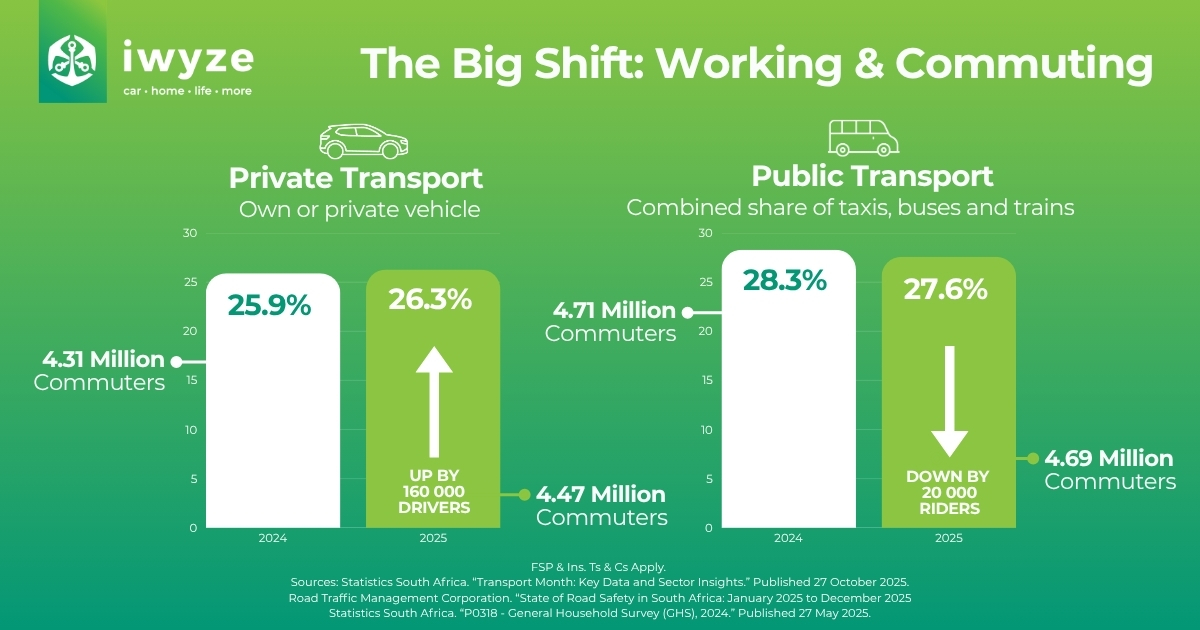
That deep need for personal security and reliable independence is precisely what drives the numbers. Stats SA’s General Household Survey shows a distinct shift in how people usually travel to work. The share of South Africans using their own car or another private vehicle increased from 25.9% in 2024 to 26.3% in 2025. Over the same period, the combined share using taxis, buses, and trains decreased from 28.3% to 27.6%.
The Big Shift: Working & Commuting
Private Transport (own or private vehicle)
2024: 25.9% [~4.31 Million Commuters]
2025: 26.3% [~4.47 Million Commuters] ▲ UP by ~160,000 drivers
Public Transport (combined share of taxis, buses and trains)
2024: 28.3% [~4.71 Million Commuters
2025: 27.6% [~4.69 Million Commuters] ▼ DOWN by ~20,000 riders
Impact Margin Tracker: The overall gap separating individual private travel from collective mass transit dramatically compressed from 2.4% down to just 1.3%.
Source: Statistics South Africa, General Household Survey 2024 (Statistical Release P0318) and General Household Survey 2025 | Statistics South Africa (Stats SA), General Household Survey (GHS) 2024 & 2025: Stats SA - Statistics South Africa (via Public) / Transport Month: Key Data and Sector Insights – Surveys sent as PDF for 2024 and 2025 (and can be downloaded here: Download survey and Download second survey)
Disclaimer: Data has been summarised and presented for illustrative purposes. Public transport figures represent the combined modal share of minibus taxis, buses, and trains. "Impact Margin" refers to the percentage point difference between public and private transport usage rates.
While these figures describe travel choices rather than why those choices changed, Weliswa points out that our car use has fundamentally adapted to economic pressures.
"The public transport landscape has definitely evolved," she says. "We now have more options beyond the traditional taxi, with e-hailing services like Uber and Bolt becoming a big part of how people get around. I also think vehicles are increasingly becoming part of the informal economy, through things like lift clubs or e-hailing, where people can use their vehicle to generate additional income."
For anyone who relies on their car to live, work, or create a side-hustle, the practical question we’re asking this Transport Month is a brutal one: if your vehicle was suddenly taken away from you, which journeys could you actually rearrange, and which would completely stall your life?
The ripple effect: excess, transport costs and lost earning time
Being without your vehicle can create costs alongside the repair bill. Depending on the claim, you may need to pay an excess. You might also need alternative transport, reschedule appointments or make another arrangement for collecting children.
"When a vehicle is involved in an accident or is out of use, the impact is far-reaching, and more than just a matter of car repairs," Weliswa warns. "There can be an immediate financial impact from having to pay an excess, as well as the additional cost of alternative transport, which most people haven’t necessarily budgeted for."
The Unexpected Cost Breakdown (Example)
If your car is out of service for just one week following an incident, the immediate out-of-pocket expenses can quickly escalate:
- Basic Excess: R6,600
- Alternative Transport: R2,000 (for example, e-hailing service from home to work daily at R200 x 2 trips per day for 5 working days)
- Total Budget Shock: R8,600
Illustrative example only
Actual excesses, transport costs and claim outcomes vary depending on the policy selected, location and individual circumstances.
What’s worse, this can have a paralysing effect on daily life, disrupting routine for the whole family, and everyone who may rely on them.
"There’s the simultaneous loss of convenience and mobility," Weliswa explains. "Things we normally take for granted, like making a quick stop at the shops after work or getting somewhere at short notice, suddenly become more difficult when you are dependent on Uber or other forms of transport."
Similarly, for someone whose work involves client visits, tools or deliveries, the disruption can affect your earning time too.
"For some people, the impact is even bigger because their vehicle is directly linked to their income," says Weliswa. "They may need it to visit clients, travel between work sites or transport goods. If they can’t use their vehicle, it can mean lost business or income, and if the disruption continues for long enough, the longer-term financial impact can be significant."
Think about your average working day, and how your vehicle plays a central role in it. From getting you to your job premises safely to making client or site visits possible, it’s more than just an asset in the underground parking lot. "For so many people, the vehicle is an enabler," Weliswa emphasises. "If you take that away, you can potentially take away someone’s ability to earn, work or support their family."
Check what your cover helps you do next
When comparing options for car insurance South Africa, you have to look past the immediate sticker price. A lower premium may save you money today, but the value of the right cover can become clear when you're on the side of the N1 at midnight and need support most, subject to policy terms, conditions, limits and exclusions.
"For me, the value of vehicle insurance is beyond enabling car repairs," Weliswa states. "It’s about covering your ability to move when something unexpected happens. Without insurance, an accident can leave you with a large unexpected expense, the cost of alternative transport and potentially lost income."
This is why looking into the fine print of your car insurance is important. Before disaster strikes, it’s crucial you know where you’re covered – and where you might need a backup plan. iWYZE Comprehensive Car Insurance includes cover for loss or damage to your vehicle from road accidents and natural disasters, subject to policy terms, conditions, limits and exclusions. To cover your safety, roadside emergency services are automatically included with a comprehensive iWYZE car or home insurance policy.
However, avoiding total vehicle downtime requires looking at how you'll travel while your car is in the panelbeater’s. Optional car hire cover is available at an additional premium and may help reduce disruption while your vehicle is being repaired, subject to the applicable terms and conditions.
As Weliswa points out, "If you have benefits like car hire, you can get back on the road quickly and continue with your work, family responsibilities and day-to-day life. Depending on your selected benefits and policy terms, insurance may help reduce the financial impact of unexpected vehicle loss or damage and assist you in maintaining mobility.”
Five #WYZE checks before your next commute
- Vehicle use: Tell your insurer how you actually use your vehicle, including any work activities, and confirm that the cover is appropriate.
- Car hire: Check whether you selected this optional benefit and read its conditions.
- Excess: Find the applicable excess amounts in your Policy Schedule and consider how you would pay them.
- Emergency assistance: Save your insurer’s emergency contact details and check which services your policy provides.
- Alternative transport: Identify a workable option for essential journeys and estimate its cost.
Your practical next step
"I think the biggest thing iWYZE would want South Africans to understand is that vehicle insurance is not just another monthly expense," Weliswa concludes. "In a country where mobility is closely linked to work, family and earning an income, your vehicle can be an important part of your financial life. It‘s therefore important to do your research on insurance, and consider cover, even if it’s not the cheapest premium. After all, you need to know what you’re receiving in return: the extent of your cover, excess, benefits and what support you will have when you need it."
Choose one ordinary working day and imagine doing it without your car. Check the journeys, commitments and costs you would need to manage. Then review your Policy Schedule and policy wording against that day.
If your work or routine has changed, contact iWYZE to discuss whether your cover still reflects how you use your vehicle. You can also explore iWYZE Car Insurance online.
This Transport Month, shift focus from the daily cost of car ownership to the real cost of being without one. Review your Policy Schedule, confirm your excess, check your selected benefits and make sure your vehicle use is accurately disclosed. If your wheels help you work, earn or live your everyday life, make sure your cover reflects that.
"Ultimately, you’re not just insuring a car," Weliswa reminds us, "Depending on your selected benefits and policy terms, insurance may help reduce the financial impact of unexpected vehicle loss or damage and assist you in maintaining mobility.”
Make sure your cover reflects your reality. Review your policy or get a comprehensive quote from iWYZE today.
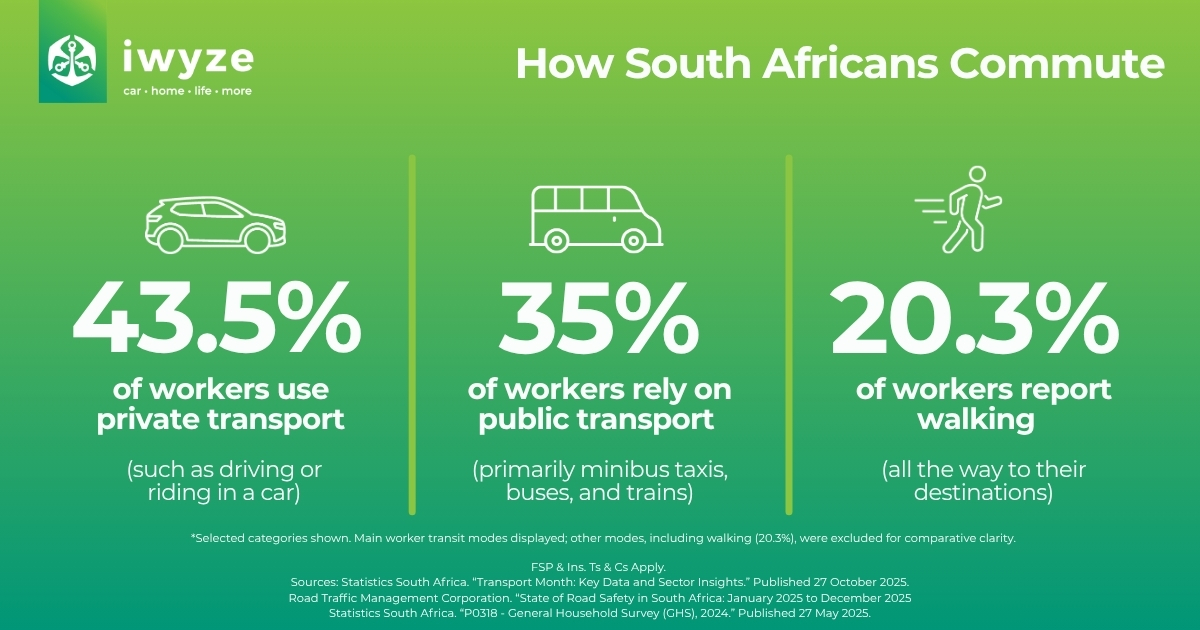
When it comes to getting to work, national transport trends reveal exactly where the commuter share is. According to the main worker travel modules released by Statistics South Africa (Stats SA), the distribution of transit choices among South African workers breaks down as follows:
- 🚗 43.5% of workers use private transport (such as driving or riding in a car).
- 🚐 35.0% of workers rely on public transport (primarily minibus taxis, buses, and trains).
- 🚶 20.3% of workers report walking all the way to their destinations.
The Main Public Transport Choice:
Among those utilising public systems, the minibus taxi stands out significantly. The Stats SA National Household Travel Survey tracks that taxis alone account for 28.1% of all work commutes nationally, keeping communities moving every single day.
If your usual mode of travel suddenly fell through tomorrow morning, what is your next move?
Disclaimer: *Selected categories shown. Main worker transit modes displayed; other modes, including walking (20.3%), were excluded for comparative clarity.
Source: Statistics South Africa (Stats SA), National Household Travel Survey Profile & Commuter Data Sheets. Verifiable via official Statistical Releases on www.statssa.gov.za – direct download: South Africa - National Household Travel Survey 2020.